LAURA POY SOLANO
La educación se mantiene entre los principales anhelos de este sector, destacan
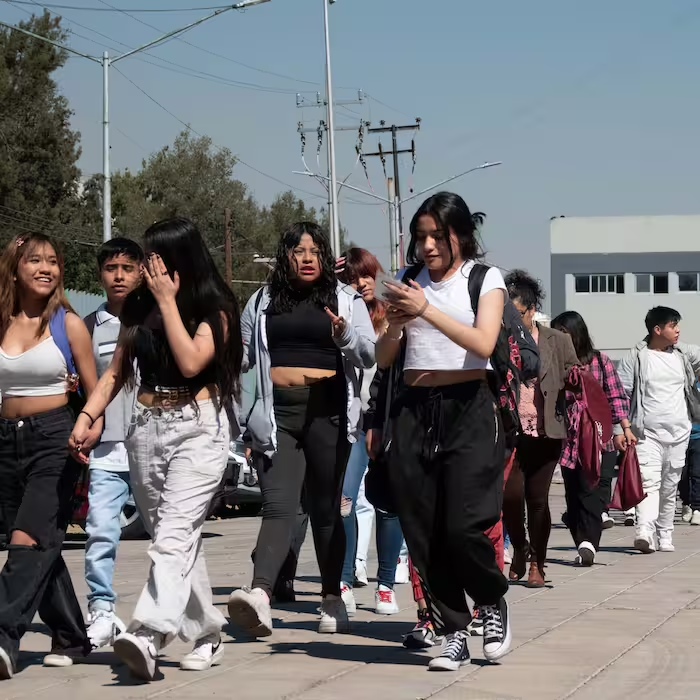
En México, al menos 4.5 millones (14.3 por ciento) de las personas de 15 a 29 años están fuera de la escuela y el empleo. A ello se suma que únicamente 10.7 millones (33.4 por ciento) se dedican a estudiar; otros 4.1 millones (12.8 por ciento) acuden a la escuela y trabajan, mientras 12.7 millones (39.6 por ciento) sólo laboran.
En la presentación del estudio Jóvenes en México 2026, elaborado por el Observatorio de la Juventud en Iberoamérica de la fundación SM, José Antonio Pérez Islas, sociólogo y pionero en el estudio de las juventudes en el país, alertó que entre 2000 y 2026 el grupo de jóvenes “desinstitucionalizados” o fuera de la escuela y el mercado laboral se incrementó de 11 a 14.3 por ciento.
En el marco del Día Internacional de la Juventud, especialistas señalaron que si bien la educación se mantiene como uno de los principales anhelos de los jóvenes en el país y obtiene una alta calificación en sus expectativas de futuro, muchos consideran que lo que se les enseña en las aulas les sirve muy poco para el mundo laboral donde buscan insertarse, pues 42.2 por ciento piensan que lo que se les imparte en la escuela no es interesante.
La encuesta, con una representatividad a nivel nacional de los 32.1 millones de jóvenes de 15 a 29 años de edad, revela que otro de los grandes desafíos para la juventud es el empleo, pues prácticamente nueve de cada 10 de quienes laboran perciben entre uno y dos salarios mínimos, y en su mayoría enfrentan condiciones de precariedad laboral.
Buscan buena paga y estabilidad laboral
En el acto, convocado en el Centro de Cultura Digital de la Estela de Luz, Pérez Islas, profesor-investigador de la Universidad Nacional Autónoma de México y ex coordinador del Seminario de Investigación en Juventud, destacó que las principales características del trabajo ideal de la mayoría de los jóvenes es que garantice una buena paga, tenga estabilidad y les permita una movilidad para adquirir nuevos conocimientos.
En cuanto a su conectividad y cultura digital, Enrique Pérez Reséndiz, profesor-investigador de la Universidad Autónoma de la Ciudad de México y coautor del estudio, destacó que si bien la tecnología forma parte de la experiencia cotidiana de las juventudes, “esto no los hace expertos en inteligencia artificial y redes sociales”.
Por el contrario, agregó, se confirma que ocho de cada 10 jóvenes mantienen un consumo pasivo, es decir, el uso de los espacios digitales se concentra en ver videos en TikTok y redes sociales (78.9 por ciento), chatear con amigos y comunicarse con su entorno (84.2), y en menor medida utilizar las plataformas digitales y la conectividad como herramientas para su educación (77.9 por ciento), a fin de seguir cursos, talleres o contenido que consideran relevante.
Los espacios digitales, agregó Pérez Reséndiz, también son considerados como herramientas laborales, pues funcionan para tener contactos y buscar empleo.
Y pese a lo que muchos piensan, indicó, los jóvenes “sí son conscientes de su consumo digital, saben de los riesgos, e incluso llegan a presentar un hartazgo de que todo lo que pueda ser relevante en su existencia tenga que pasar forzosamente por un espacio digital”.
Por su parte, Mónica Valdez González, socióloga y también coautora del estudio, señaló, en cuanto al consumo cultural, que los jóvenes manifiestan su gusto por leer (58.6 por ciento). Además, seis de cada 10 prefieren el formato tradicional de papel al digital. Sin embargo, alertó, el número de libros leídos por año, por obligación o placer, es bajo, pues sólo 13.3 leen seis o más libros al año.
*English version
4.5 million young people are unemployed and out of school: study
LAURA POY SOLANO
Education remains among the top aspirations of this sector, experts emphasize.
In Mexico, at least 4.5 million (14.3 percent) of people aged 15 to 29 are neither in school nor employed. Furthermore, only 10.7 million (33.4 percent) are currently studying; another 4.1 million (12.8 percent) attend school and work, while 12.7 million (39.6 percent) are only employed.
At the presentation of the study “Youth in Mexico 2026,” prepared by the Ibero-American Youth Observatory of the SM Foundation, José Antonio Pérez Islas, a sociologist and pioneer in the study of youth in the country, warned that between 2000 and 2026, the group of “disinstitutionalized” or unemployed young people increased from 11 to 14.3 percent.
On International Youth Day, experts pointed out that while education remains one of the main aspirations of young people in the country and receives high marks in their future expectations, many believe that what they are taught in the classroom is of little use to the job market where they seek to enter, with 42.2 percent thinking that what is taught in school is not interesting.
The survey, with a national representation of the 32.1 million young people aged 15 to 29, reveals that another major challenge for young people is employment, as practically nine out of ten of those who are employed earn between one and two minimum wages, and most face precarious working conditions.
They Seek Good Pay and Job Stability
At the event, held at the Digital Culture Center of the Estela de Luz monument, Pérez Islas, a professor and researcher at the National Autonomous University of Mexico and former coordinator of the Youth Research Seminar, emphasized that the main characteristics of the ideal job for most young people are that it guarantees good pay, offers stability, and allows them to move around and acquire new knowledge.
Regarding their connectivity and digital literacy, Enrique Pérez Reséndiz, a professor and researcher at the Autonomous University of Mexico City and co-author of the study, pointed out that while technology is part of young people’s daily experience, “this does not make them experts in artificial intelligence and social media.”
On the contrary, she added, it is confirmed that eight out of ten young people maintain a passive consumption pattern; that is, their use of digital spaces is concentrated on watching videos on TikTok and social media (78.9 percent), chatting with friends and communicating with their social circle (84.2 percent), and to a lesser extent, using digital platforms and connectivity as tools for their education (77.9 percent) in order to follow courses, workshops, or access content they consider relevant.
Digital spaces, Pérez Reséndiz added, are also considered work tools, as they serve to make contacts and look for employment.
And despite what many think, she indicated, young people “are indeed aware of their digital consumption, they know the risks, and even express weariness that everything that could be relevant in their lives has to necessarily pass through a digital space.”
For her part, Mónica Valdez González, a sociologist and also co-author of the study, noted, regarding cultural consumption, that young people express a liking for reading (58.6 percent). Furthermore, six out of ten prefer the traditional paper format to digital. However, he warned that the number of books read per year, whether for work or pleasure, is low, as only 13.3% read six or more books annually.

 Agregar a favoritos